


Do Illinois Police Need a Search Warrant To Search My Car for Drugs?
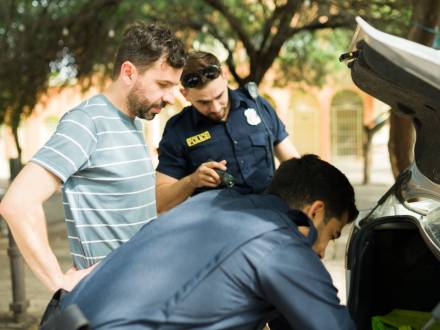
Illinois police usually do not need a warrant to search your vehicle. Courts treat cars differently from homes. What officers do need is a legal basis, such as probable cause or valid consent. Other exceptions allow limited searches after an arrest or when a vehicle is lawfully impounded. A hunch does not.
When officers search without a valid legal basis, the defense can ask the court to exclude the evidence. If police searched your car for drugs in 2026, an Elgin, IL criminal defense lawyer can examine whether the search was lawful.
When Can Illinois Police Search a Car Without a Warrant?
Probable cause is the broadest exception. When officers have specific facts giving them reason to believe a vehicle contains evidence of a crime, they can search areas where that evidence might be found. This includes the trunk and closed containers inside.
Consent is the second, and it is the one you control. An officer can ask, and you can decline. Consent has to be voluntary, and the search cannot go beyond what you authorized.
A search after an arrest is narrower than people assume. Officers can search the passenger compartment if the arrested person could reach it or if they reasonably believe it contains evidence related to the arrest.
Inventory searches follow a tow. The impoundment has to be lawful, and officers have to follow standardized procedures. Those procedures do not always need to be written. Officers may also seize contraband in plain view when they have lawful access to it.
Does the Smell of Cannabis Justify a Vehicle Search in Illinois?
The Illinois Supreme Court held in 2024 that the odor of burnt cannabis alone does not give officers probable cause to search a vehicle. In People v. Redmond, the court explained that legal cannabis use means the smell alone does not establish criminal activity. Other evidence can still justify a search.
In People v. Molina, the court reached a different conclusion about raw cannabis. Its smell alone can establish probable cause when an officer trained and experienced in distinguishing raw from burnt cannabis detects it coming from a vehicle on a highway.
The reason sits in 625 ILCS 5/11-502.15, which generally requires cannabis in a vehicle to be kept in a secured, sealed or resealable, odor-proof, child-resistant container that is inaccessible. An exception applies in some cases when cannabis was lawfully purchased from a licensed dispensary and remains in its original packaging.
An officer's description of the odor, training, and observations can determine whether the search was lawful.
How Long Can Illinois Police Detain You During a Traffic Stop?
A traffic stop can last only as long as reasonably necessary to address the violation and related safety checks. Officers can check your license, registration, and outstanding warrants while preparing a citation.
Extending the stop beyond that point requires new reasonable suspicion developed during the encounter. Under Rodriguez v. United States, even a short delay for a drug-sniffing dog can violate your rights without that justification.
Canine sniffs themselves do not require a warrant when conducted during a lawful stop. The problem arises when the inspection unnecessarily extends the detention, regardless of whether the officer has finished writing the ticket.
Timing evidence comes from dash and body camera footage, dispatch logs, and other records showing how long the encounter lasted. Requesting those records early matters, since agencies overwrite recordings on a schedule.
How Can You Challenge an Illegal Vehicle Search in Illinois?
One way to challenge an illegal vehicle search is to ask the court to exclude evidence obtained. A judge examines the reason for the stop, the facts supporting the search, and whether officers followed legal limits. When disputed facts require a hearing, officers can testify, and the defense can question them. Video recordings and police reports can reveal inconsistencies.
Common challenges involve stops without reasonable suspicion, unnecessary delays, searches beyond the scope of consent, and inventory searches conducted without lawful impoundment or standardized procedures.
If the judge grants the motion, the State generally cannot use the excluded evidence against you. Prosecutors then assess what remains, and the case can be dismissed if the remaining evidence is insufficient.
Schedule a Free Consultation With Our Kane County, IL Criminal Defense Attorney
Attorney Brian J. Mirandola is a former Assistant State’s Attorney with over 25 years of criminal law experience. He knows how the State builds a case around a vehicle search and which parts of an officer’s account tend not to survive a suppression hearing, which can be an important stage of a drug possession case. If you are facing drug charges after a vehicle search in 2026, Attorney Mirandola can review the evidence and identify possible violations of your rights.
Contact The Law Office of Brian J. Mirandola at 847-488-0889 to talk to our Elgin, IL criminal defense lawyer today.


Get The Representation You Deserve
Call 847-488-0889 or Fill Out The Form Below To Set Up a Free Consultation Today:


Results listed are not a guarantee or indication of future case results.

