


What Happens when Probation is Violated in Illinois?
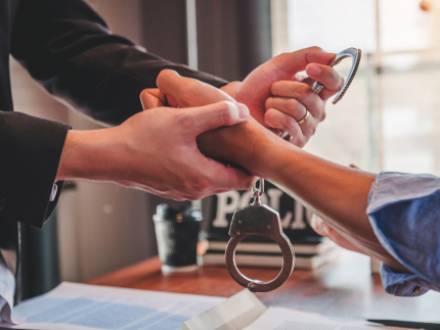 If you violate probation in Illinois, you may very likely need to attend a court hearing and face serious consequences. But some violations can be handled without a formal violation proceeding. If you are accused of violating probation, the court holds a hearing to decide whether the violation occurred. If it did, the judge decides what should happen next. This can range from continuing probation to revocation and jail or prison time.
A violation does not automatically mean you are going to prison. What happens in your case depends heavily on what you did and whether you work cooperatively with the court and a good attorney. If you are accused of a probation violation in 2026, our Kane County criminal defense lawyer can help you understand what to expect.
How Is a Probation Violation Handled in Illinois?
Under 730 ILCS 5/5-6-4, the court must hold a hearing before probation can be revoked. This happens once a petition is filed alleging a violation. At a probation violation hearing, you have several rights:
- The right to written notice of the alleged violation
- The right to be represented by an attorney
- The right to see the evidence against you and question witnesses in open court
These protections mean the state cannot simply take away your probation based on an accusation alone.
What’s the Standard of Proof at a Probation Violation Hearing?
The state must prove a violation by a "preponderance of the evidence." This means it is more likely than not that the violation occurred. This is a lower bar than the standard used in a criminal trial, where guilt must be proven beyond a reasonable doubt. Because of this lower standard, a probation violation hearing can move forward even in situations where a full criminal conviction might not have been possible.
Does the Reason for a Probation Violation Affect How Much Trouble You Get Into?
The reason for a probation violation can affect how the court handles the case. Illinois law does not require the State to prove that every probation violation was done on purpose. However, the circumstances surrounding the violation do make a difference when the judge decides what should happen next.
For example, a missed drug test might be treated differently depending on the reason behind it. One caused by a medical emergency or not being able to get off work looks very different from one missed several times with no explanation. When it comes to probation payments, Illinois law says probation cannot be revoked unless the failure to pay was a willful refusal, not just an inability to pay.
Situations That May Excuse a Probation Violation
Job loss, illness, transportation problems, or other documented hardships can help explain why a requirement was missed. These circumstances may affect how the judge responds to the violation.
Helpful evidence can include:
- Medical records explaining a missed appointment, test, or requirement
- Proof of employment or a work schedule that conflicted with a specific condition
- Documentation showing completion of counseling, classes, or treatment programs
- Communications with a probation officer about a scheduling problem or hardship
Presenting this evidence at the hearing can affect the court's decision about what should happen next.
What’s the Difference Between a Technical Probation Violation and a New Criminal Offense?
A technical probation violation involves failing to meet a specific condition of probation, such as missing a meeting or a required class. A totally different type of violation happens when someone breaks a criminal law while on probation.
An arrest or criminal charge leads to a probation violation proceeding. But the arrest or charge alone does not prove that you committed a new crime. Courts typically treat conduct involving a new criminal offense more seriously than a technical probation violation.
What Happens at a Probation Violation Hearing?
If a judge finds that you violated probation, several outcomes are possible. Probation could continue with just a warning, or come with new conditions like more frequent check-ins or additional treatment. The judge could also extend how long probation lasts. In more serious cases, probation is revoked entirely, and the original sentence, which can include jail or prison time, takes effect.
Schedule a Free Consultation With Our Kane County, IL Criminal Defense Attorney
A probation violation allegation deserves the same serious attention as an original criminal charge. Having experienced legal representation can make a significant difference. Attorney Brian J. Mirandola is a former Assistant State's Attorney. He brings more than 25 years of criminal law experience to these cases. He understands, firsthand, how prosecutors and judges evaluate alleged violations.
If you are facing a probation violation, contact The Law Office of Brian J. Mirandola today. Schedule a free consultation with our Elgin, IL criminal defense lawyer.


Get The Representation You Deserve
Call 847-488-0889 or Fill Out The Form Below To Set Up a Free Consultation Today:


Results listed are not a guarantee or indication of future case results.

